The Cup of Tea Goes Cold: On Hospital Corridors and the Work of Staying
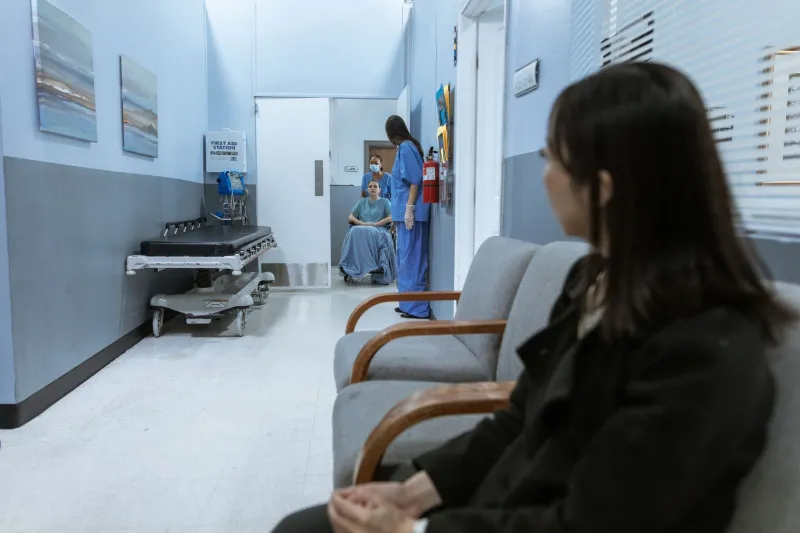
At three in the morning, the corridor outside a medical assessment unit has its own weather. The vending machine hums like a distant refrigerator; the floor polish throws back a greenish light; the plastic chairs have been bolted into rows that face nothing in particular. A man in a fleece is sleeping upright, an overnight bag wedged between his feet. Somewhere behind the double doors, a trolley rattles. Nobody is doing anything that would show up on a rota.
This is the place where service becomes almost entirely invisible. Not the drama of the emergency itself, but the long, undramatic aftermath: the waiting. In NHS hospitals across Britain, relatives learn a new timetable. They learn when the ward round is likely to begin, when the tea trolley comes, when the night staff change shift, when the consultant might appear with a clipboard and a face that gives nothing away. They learn the geography of the League of Friends café, the price of the car park, the exact distance from the bus stop to the discharge lounge. They become, without anyone saying so, experts in staying.
The Geography of Waiting
Waiting rooms are not neutral spaces. They are built for throughput, not for grief. The chairs are wipe-clean; the notices are laminated; the clock is slightly wrong. There is a television playing daytime property programmes to an audience that cannot concentrate on them. Everything is designed to be temporary, and yet people arrive with enough luggage for a fortnight. A rucksack. A phone charger. A paperback whose pages never turn. A flask that goes cold by mid-morning.
The waiting room is a place of strange equality. Company directors sit beside care workers; grandmothers beside teenagers; the devout beside the indifferent. Illness does not much care for status. And nor, in the end, does the waiting. Everyone is reduced to the same posture: leaning forward, hands clasped, eyes on the double doors.
The Etiquette of the Ward
There is an unwritten code among those who keep vigil. You do not take the chair nearest the socket unless you need it. You offer to fetch tea. You learn to read the faces of the nurses for news before anyone speaks. You discover that a surgeon's reassurance is a different genre from a registrar's caution. You become fluent in the small vocabulary of hope: 'stable', 'comfortable', 'doing well', 'waiting for a bed'.
This etiquette is a form of neighbourliness, though nobody would call it that. It is the quiet business of making room for other people's fear. A woman I once met in a cardiology corridor had been there for nine days. She had a folding stool, a crossword book and a system for charging her phone. She had also, by the end, become the unofficial welcome party for every new arrival: pointing out the toilets, explaining the parking app, sharing the number for the hospital chaplaincy. She had no official role. She had simply stayed long enough to become useful.
Presence Against Solution
Modern life trains us to solve. We are a nation of problem-solvers, organisers, forward-planners. When someone is ill, our instinct is to ask what can be done: which consultant, which treatment, which form, which complaint. All of this matters. But there comes a point in the corridor when no useful action remains. The tests are running. The scan is booked. The consultant is in theatre. The only available task is to sit down and remain.
This is harder than it sounds. Staying requires a kind of ego-renunciation. It means accepting that you are not the protagonist of the story. It means resisting the urge to fill silence with advice, or to turn anxiety into busyness. It means learning the difference between being present and merely being there.
The Liturgy of the Tea Trolley
The tea trolley is the closest thing the ward has to a liturgy. It arrives at roughly the same time each afternoon, pushed by someone who has probably not slept enough. The cups are plastic; the tea is strong; the biscuits are usually plain. And yet the ritual matters. It marks time. It gives strangers something to do with their hands. It creates a brief, ordinary community around a trolley that smells faintly of toast.
In a place where so much is uncertain, the tea trolley is a small assurance that the day has a shape. It is not a solution to anything. It is simply a kindness, repeated.
The Cost of Staying
We should be honest about the cost. Staying is tiring. It is boring. It plays havoc with work, with sleep, with the small economies of family life. Carers and relatives across the UK know this in their bones. The overnight bag becomes a second home; the hospital car park becomes a second address. There is nothing glamorous about it.
And yet there is a peculiar dignity in it too. The Christian tradition speaks of a God who did not stay at a distance but came and pitched his tent among us. Incarnation is not an idea about nearness; it is the nearness itself. To sit by a bed, to keep watch, to stay when there is nothing to be done, is to imitate something at the heart of faith: the refusal to abandon.
The Chair by the Bed
The chair by the bed is not a symbol of helplessness. It is a place of work. It is where love becomes practical in the only way left available. It is where faith is stripped of its rhetoric and reduced to a flask of tea and a phone charger. It is where neighbourliness is measured not in grand gestures but in hours.
So perhaps the question for our churches, our communities and ourselves is not 'What can we do?' but 'Who will stay?' The corridor at three in the morning is not a place of answers. But it is a place where presence can become a kind of prayer. And sometimes, quietly, that is enough.