The Hand That Stops the Traffic: On Attention, Protection and the Common Good
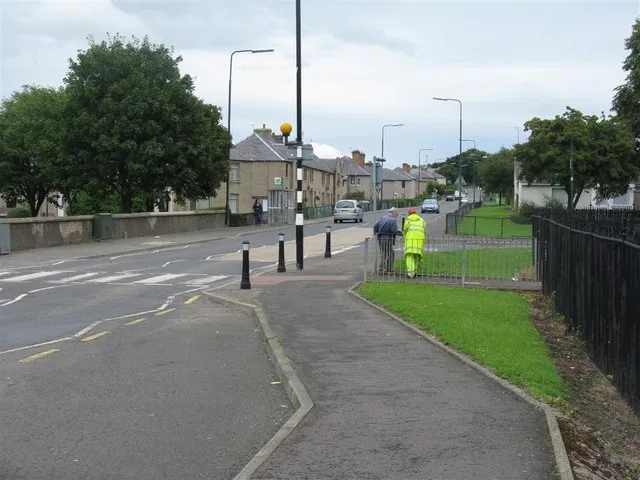
Photo: M J Richardson, CC BY-SA 2.0, via Wikimedia Commons
On a wet November morning in 2026, a woman in a high-visibility coat stands at the edge of a suburban road. She holds a pole with a circular sign. The rain has made the tarmac dark and the drivers impatient. A line of children gathers on the pavement, some in coats too large for them, some holding a parent's hand, some already old enough to be embarrassed by being seen off. She waits for a gap, steps into the road, raises the sign, and the traffic stops.
The school crossing patrol is one of the most familiar figures in British public life and one of the least examined. For more than half a century, local authorities have paid people to stand in roads at the beginning and end of the school day. The role is often affectionately called the lollipop lady, though the patrol officer may be a man, and the sign is more lollipop-shaped than the person. It is a small office. It is also a daily enactment of a promise: adults will not let children cross alone.
Eight Twenty in the Rain
Watch a crossing for a week and you begin to see what the job actually is. It is not simply traffic management. The patrol officer gathers a scattered neighbourhood into a temporary procession. She learns names. She notices which child is late, which parent is absent, which buggy has a wobbly wheel. She sees the same faces in different weathers. She becomes a fixed point in a shifting day.
The sign is a small piece of theatre, but the authority is real. Drivers stop because the law says they must, and because a human being is standing in the road. There is a difference between a pelican crossing and a person. The crossing is a machine; the patrol officer is a neighbour. The machine regulates. The neighbour recognises.
The Economics of a Raised Hand
In recent years, many councils have reviewed their school crossing patrol budgets. A patrol is a recurring cost: wages, training, uniform, insurance, cover for sickness. When budgets are stretched, it can look like a small saving. A pedestrian crossing may be cheaper in the long run, or it may not. A crossing requires infrastructure, maintenance and road layout. A patrol officer requires a person willing to stand in the rain.
The spreadsheet can count the cost of employing someone. It struggles to count the cost of not doing so. It cannot easily measure the parent who now drives a child to school because the walk feels unsafe, or the child who learns that the street is a place where no adult is waiting. It cannot measure the small erosion of trust that follows when a familiar figure disappears. These are not arguments against prudent budgeting. They are arguments for seeing that some savings are withdrawals from a common account that is difficult to replenish.
Attention as a Form of Love
To watch over is to pay attention. The patrol officer does not merely stop cars. She watches children. She watches the road. She watches the weather and the clock. In religious language, attention is close to prayer: a disciplined turning towards what is before you, without the distraction of self-interest. The patrol officer is not a priest, and the crossing is not a sanctuary. But the daily liturgy is there: arrive, look, wait, signal, greet, repeat.
The sacredness of ordinary protection is easy to miss because it is so ordinary. A hand raised. A sign lifted. A child waved across. A driver acknowledged. These are small gestures, but they are not trivial. They teach children that the world contains adults who will make space for them. They teach drivers that the road is a shared place, not a private track. They teach a neighbourhood that care can be institutional and personal at the same time.
What the Crossing Teaches
Service is often imagined as dramatic: the emergency responder, the missionary, the campaigner. But the common good is built from small, repeatable acts that are almost too mundane to notice. The patrol officer is a public servant in the plainest sense. She is paid to be present. She is paid to look. She is paid to put her body between a child and a car.
That last point is worth pausing over. The patrol officer is not a security guard or a police officer. She has no power of arrest. Her authority is a sign, a uniform and a social agreement. Yet she embodies a contract that is older and deeper than any council budget: the strong will not ignore the vulnerable; the fast will yield to the slow; the adult will stand in the road for the child.
When that figure disappears, something is lost in the moral atmosphere. The street may still be crossable. The children may still get to school. But the lesson has changed. They learn that no one is waiting, and that safety is a matter of individual vigilance rather than shared care.
The Cost of Looking Away
Not all cuts are avoidable. Councils face hard choices, and it is easy for a newspaper to defend a beloved figure without acknowledging the arithmetic. But the decision to stop paying someone to stand in the road is a decision about what kind of society we think we are. It is a decision about whether protection is a public good or a private responsibility. It is a decision about whether children are a common concern or a family matter.
The patrol officer does not resolve these arguments. She simply stands in the road and raises her sign. In 2026, that small act remains a quiet rebuke to the idea that everything must be efficient before it can be good. She is not a symbol. She is a person doing a job. But the job is a liturgy of care, and the care is worth noticing.