What the Soldering Iron Knows: Mending as a Neighbourly Vocation
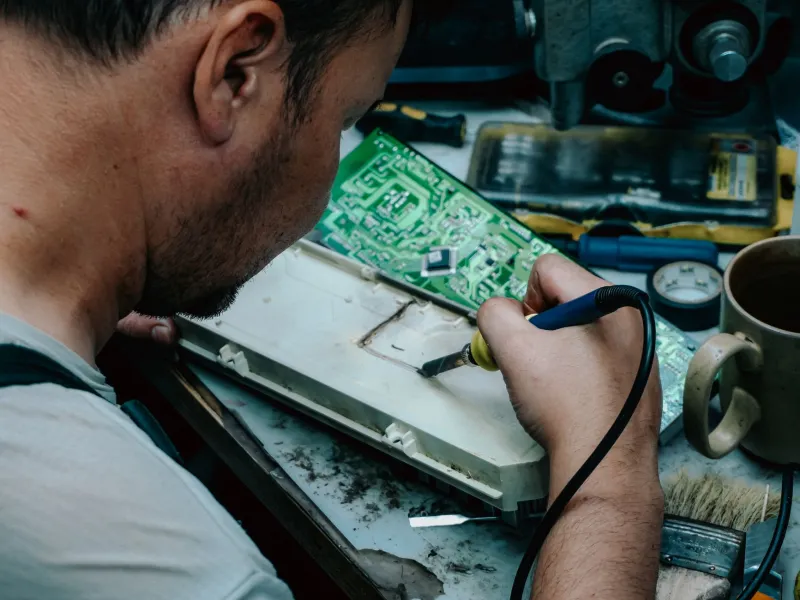
On a wet Saturday morning in a church hall somewhere in the English provinces, a queue forms beside a trestle table. A toaster with a dead element. A lamp with a frayed cord. A pair of trousers needing a hem. A radio that has been silent for years. In 2026, as household budgets remain tight and high streets continue to change, such scenes are repeated in community centres, libraries and church rooms across the United Kingdom. The repair café is not a new idea, but it is a quietly radical one: it assumes that broken things deserve a second look, and that the people who own them deserve company while they wait.
The volunteers who staff these tables are not usually professionals. They are retired engineers, seamstresses, electricians, students, hobbyists and neighbours. They do not promise miracles. They promise presence. A screwdriver is produced, a multimeter is consulted, a seam is unpicked. The object is the pretext. What is being repaired is not only a fuse or a hem but a relationship between people and the made world, and often between people and one another.
The Table in the Hall
The setting matters. A church hall stripped of ornament, smelling faintly of instant coffee and floor polish, is not a cathedral. But it is a place set apart for a purpose. The trestle table becomes a kind of altar of ordinary things. Around it, strangers become neighbours because they have been given a task to share. One person holds the torch while another solders. Someone explains why a washing machine has been designed to be difficult to open. Someone else listens.
This is service in its least glamorous form. There is no stage, no applause, no ribbon to cut. There is only the slow work of attending to what is in front of you. In a culture that rewards visibility, such work is almost invisible. Yet it carries the quiet weight of a vocation. The volunteer is not merely fixing a kettle. He or she is saying, in effect: your problem is not beneath notice; your object is not rubbish; your time is not wasted here.
A Secular Liturgy of Attention
The word liturgy means the work of the people. It is usually applied to worship, but it can also describe any repeated pattern of action that shapes a community. Repair cafés have their own small liturgy. Arrive. Greet. Listen. Diagnose. Explain. Test. Repeat. There is no congregation and no creed, but there is a rule: stay with the thing until it works, or until you can say honestly why it cannot.
That rule is a form of hospitality. It resists the impatience of a throwaway economy, where the cheapest response to a fault is replacement. It also resists the impatience we often show one another. To sit with a broken object is to practise a kind of faithfulness. To sit with the person who brought it is to practise something closer to love.
Not everyone in the room would use the language of faith. Many would not. Yet the practice rhymes with it. The Christian tradition has long insisted that ordinary matter can bear meaning: bread, wine, water, oil, a hand laid on a shoulder. A repair café makes no such claims for itself. But it does treat the material world as worthy of care. It treats the broken as salvageable. It treats the neighbour as someone to be met rather than managed.
The Moral Life of Objects
Objects carry memory. A radio inherited from a father. A coat bought for a first job. A child's toy repaired so often that it has become a family relic. When volunteers mend such things, they are not merely conserving plastic and metal. They are acknowledging that human lives are tangled up with stuff, and that contempt for the made world can become contempt for the people who live in it.
This is where the repair café touches something sacramental. A sacrament is not magic; it is a visible sign of an invisible grace. The sign here is modest: a solder joint, a patch, a replaced plug. The grace is equally modest: the relief of a pensioner who cannot afford a new kettle, the delight of a child whose toy speaks again, the dignity of a man who has been listened to for twenty minutes without being sold anything.
Grace rarely arrives as a grand gesture. More often it arrives as a second pair of hands.
The Politics of Unmaking
Repair cafés are not a substitute for policy. They cannot undo the economics of cheap manufacturing, planned obsolescence or the disappearance of local repair shops. They should not be asked to. But they do expose a question that consumer culture prefers to avoid: what kind of society treats throwing away as the default? The answer is not simply a matter of individual virtue. It is a matter of design, regulation, taxation and the value we place on labour.
Still, the small resistance matters. Every repaired toaster is a small argument against waste. Every repaired relationship is a small argument against loneliness. Many visitors come for the fuse and stay for the conversation. Some come because they have no one else to talk to. The repair café does not advertise itself as a remedy for isolation, but it often becomes one, because it gives people a reason to be together that is neither commercial nor sentimental.
A Calling Without a Collar
The ministry of small repairs is not a ministry of spectacle. It asks for patience, modesty and the willingness to be useful without being noticed. It is a reminder that service is not a slogan or a sector. It is a way of standing in relation to the world: hands open, attention given, the neighbour's broken thing treated as mattering.
In 2026, Britain needs large arguments about care, community and the common good. It also needs small rooms where those arguments become practical. The repair café is one such room. It makes no claim to save the world. It simply refuses to abandon a toaster, a radio or a person. That refusal, repeated week after week, is closer to faith than it might first appear.