The Mirror, the Radio, the Chair: How Barbershops Practise the Art of Noticing
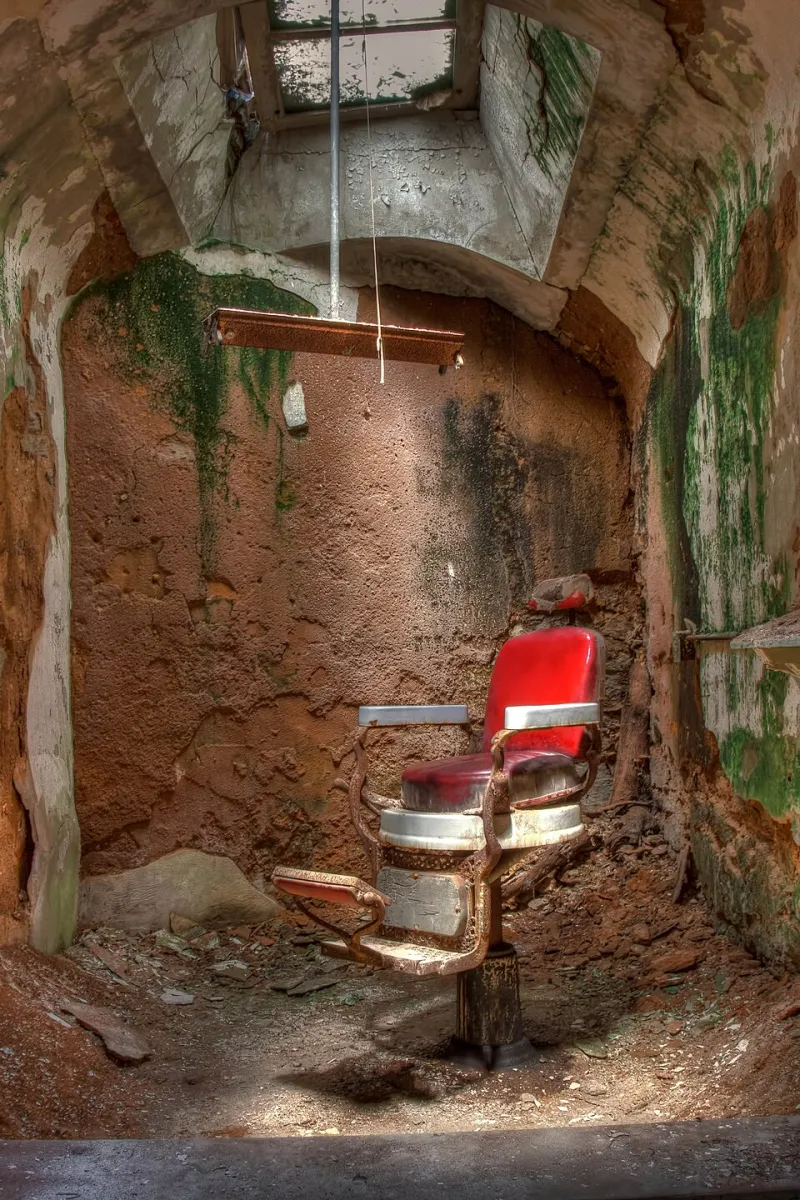
Photo: Sandy Horvath-Dori from Grand Junction, CO, USA, CC BY 2.0, via Wikimedia Commons
The barbershop on the high street opens before the shutters of the estate agent and the charity shop. On a wet Tuesday in November, the window is steamed at the bottom, and the chair nearest the glass holds a man in a cape, staring at a mirror that reflects a street he has known for decades. The radio is on, not loud. The barber asks the first question of the day: “Much off?” It is a small sentence, but it is also a door.
A Script That Makes Room
Small talk has a poor reputation. It is dismissed as filler, the weather made verbal. But in the barbershop it performs a precise social function: it gives a stranger a way in and a way out. The questions are not interrogation; they are handles. “Busy today?” “Anywhere nice?” “Still working at the same place?” The customer can take hold of one, or let it pass. The barber reads the answer and adjusts. This is a craft, though it rarely announces itself as one.
Churches and community groups often speak of welcome, and rightly so. But welcome is easier to proclaim than to construct. The barbershop constructs it out of repetition and low stakes. It does not demand that a person reveal themselves. It offers a script that can become, in time, a relationship. The surface is not the enemy of depth. Sometimes it is the only safe way down.
The Spare Chair as an Argument
Every barbershop has a chair that is not in use. It is not merely furniture. It is a place kept open. Someone might come. The shop could fill every slot by appointment and turn nobody away, but the spare chair is a quiet statement: there is room, and time is not yet fully claimed. In a culture of booked calendars and funded projects, that is a modest radicalism.
The spare chair also absorbs waiting. Men who would not sit in a café alone will sit in a barbershop. They will read a newspaper that is three days old, or watch the traffic, or listen to two strangers argue about football. They are not there to be helped. They are there because the room is warm and the chair is available. Loneliness is often not a dramatic crisis but a low-grade absence of somewhere to be. The barbershop is somewhere.
The Barber Who Notices
Barbers see the same heads every few weeks. They notice the hairline, the scar, the weight lost or gained, the new job, the absence of the usual chat. They are not therapists and should not be conscripted as such. But they are practitioners of continuity. A barber might say, “You’re quiet today.” It is not a diagnosis. It is an invitation, and it can be declined without penalty.
This is a form of pastoral attention without the pastoral title. The Church has long understood the value of the ordinary visit, the cup of tea, the repeated greeting at the same door. The barbershop has its own version: the mirror, the radio, the chair. It is not a sacrament, but it has something of the shape of one: a bounded time, a listening ear, an ordinary person on the other side of the mirror.
The Limits of the Model
It would be easy to romanticise. Not every barbershop is a haven. Small talk can exclude as well as include. A customer may be silent because he is tired, or because he does not trust the room. Some shops are rushed, some are expensive, some are simply not for everyone. The barbershop is not a substitute for mental health services, nor for the slower work of friendship.
But the limits do not cancel the lesson. Care often arrives in unremarkable containers. The church hall, the food bank, the allotment, the barbershop. The question for community groups is not how to become a barbershop, but what they might borrow from one: keep a spare chair, ask a question that can be refused, notice the quiet, and do not mistake the absence of a programme for the absence of service.
The Chair by the Window
In 2026, loneliness is a public concern and a private ache. Local authorities publish strategies; charities run befriending schemes; churches open their doors. All of this matters. But the most durable service is often the least official. It is the shop that opens early, the barber who remembers, the chair that waits.
The man in the cape will leave with a shorter haircut and a few minutes of ordinary company. Nothing has been solved. But something has been carried. The chair by the window is empty again, and it is ready. That is a ministry of a kind, though nobody would call it that. It is the quiet work of making room.