The Curb-Side Vigil: Bin Day and the Unwritten Rules of Neighbourliness
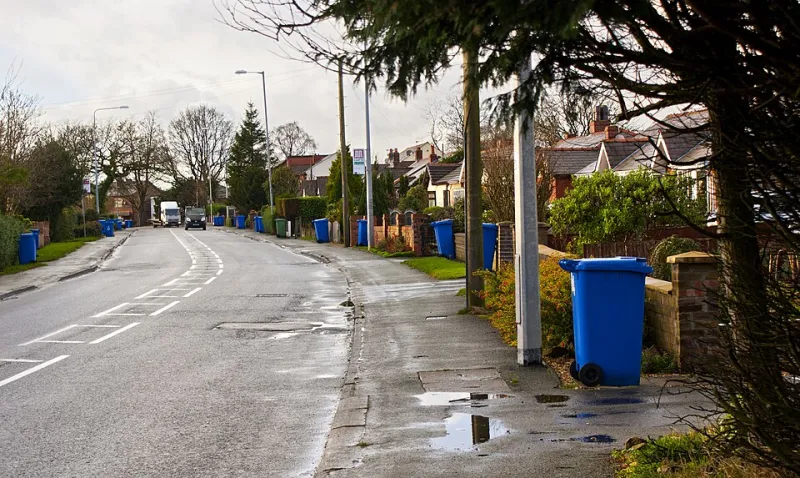
Photo: Ian Greig , CC BY-SA 2.0, via Wikimedia Commons
On a wet November morning, before the curtains have opened on half the street, a small procession begins. It is not solemn. There are no robes, no hymns, no gathering of the faithful. There are only wheelie bins, recycling boxes and the soft clatter of plastic on paving. A figure in a dressing gown appears at a gate, wheels out a neighbour's bin because the neighbour is away, and disappears again before the kettle has boiled. The street has performed its first act of service, and almost nobody has seen it.
We do not usually think of bin day as a moral occasion. It is a matter for councils, calendars and the weather. But the unglamorous logistics of shared life are often where character is most plainly revealed. A street can be measured by the things its residents remember on behalf of one another: the bin put out in time, the recycling box brought in before it blows down the road, the assisted collection arranged for someone who can no longer manage the journey to the kerb. These are not grand gestures. They are the small, repeatable acts by which a collection of houses becomes a neighbourhood.
The Logistics of Being Neighbourly
A wheelie bin is a ridiculous object to load with meaning. It is bulky, ordinary and faintly embarrassing. Yet its journey to the kerb depends on a chain of assumptions that we rarely examine. We assume the council will collect. We assume the truck will come. We assume that someone in the house is well enough, present enough and organised enough to remember. When those assumptions hold, nothing happens. When they fail, the street learns something about itself.
The person who wheels out a neighbour's bin is not usually trying to be heroic. They are responding to a small piece of local knowledge: that the neighbour is in hospital, or on holiday, or has a bad back, or has recently been widowed. This knowledge is not stored in a database. It is carried in the minds of people who pay attention. It is a form of civic memory, maintained by the unglamorous discipline of noticing.
There is a temptation to dress this up as charity. It is better understood as neighbourliness, which is a more demanding and more reciprocal thing. Charity can be occasional and one-directional. Neighbourliness is habitual and shared. It assumes that the street is a common project, however modest, and that each household has a part to play in keeping it habitable. The person who brings in a bin for someone else is not merely being kind. They are acknowledging an obligation that runs in both directions, even if the other direction is currently unseen.
What a Missed Collection Reveals
A missed collection is a small crisis with a long tail. The bin sits out for another fortnight. The smell changes. The foxes become interested. The neighbours begin to speculate. Was it forgetfulness, illness, absence, or something more serious? The unanswered bin becomes a question mark at the edge of the pavement.
In this sense, the missed collection is a diagnostic tool. It reveals the thickness or thinness of the local social fabric. On some streets, a bin left out for more than a day will prompt a knock at the door. On others, it will be ignored for weeks. The difference is not usually a difference in kindness. It is a difference in attention. Some streets have developed habits of mutual noticing; others have not. The bin is simply the object through which the habit becomes visible.
This is where faith and community have something to learn from the people who notice what others forget. The great religious traditions have always insisted that love of neighbour is not an abstraction. It is worked out in concrete, often tedious ways: food, shelter, company, the sharing of burdens. The bin is not a burden in any grand sense. But the willingness to notice a small burden is a rehearsal for noticing larger ones. A street that cannot remember a bin may struggle to remember a bereavement. A street that has learned to keep a mental map of who is away, who is unwell and who might need help is already practising a form of pastoral care, even if it would never use the word.
The Moral Life of a Street
Bin day also exposes the limits of formal systems. Councils can publish calendars, send reminders and provide assisted collections, but they cannot supply the informal watchfulness that makes a street feel safe. That watchfulness is not a service to be commissioned. It is a culture to be cultivated. It grows through small conversations at the gate, through the exchange of mobile numbers, through the willingness to ask a neighbour whether they need anything while you are at the shop.
There is a quiet provocation in all this for communities of faith. We are often drawn to the visible and the declarative: the service, the meeting, the public act of worship. But the moral life of a street is sustained by things that are almost invisible. The bin brought in before the rain. The parcel taken in and left with a note. The car moved so the lorry can pass. These acts do not announce themselves. They are the liturgy of the ordinary, performed by people who may have no religious language for what they are doing.
If there is a sermon in bin day, it is preached in the conditional tense: I will put yours out if you are away. I will bring it in if you are late. I will knock if it is still there tomorrow. The conditional becomes a promise, and the promise becomes a habit, and the habit becomes the kind of street where people can afford to be forgetful because someone else is paying attention.
The Ministry of the Unremarkable
None of this is sentimental. Streets can be difficult places. Neighbours fall out. Bins are left out in passive aggression. Collections are missed because of strikes, weather or simple incompetence. The moral life of a street is not a story of constant harmony. It is a story of small repairs, repeated after failure. The person who wheels out a bin after a disagreement is not pretending the disagreement did not happen. They are refusing to let it become the whole story.
This is the quiet weight of things. The kingdom of God is not usually announced by a fanfare in a cul-de-sac. It is announced by a bin moved six feet to the kerb because someone remembered that their neighbour could not. It is announced by a street that has learned to keep faith with the unremarkable. In a culture that rewards the spectacular, there is something quietly provocative about a life organised around the question: what does this street need from me today?
The answer is often small. It is often plastic. It is often before breakfast. But it is service, and it holds the street together.