A Seat for the Stranger: Memorial Benches and the Quiet Duty of Making Room
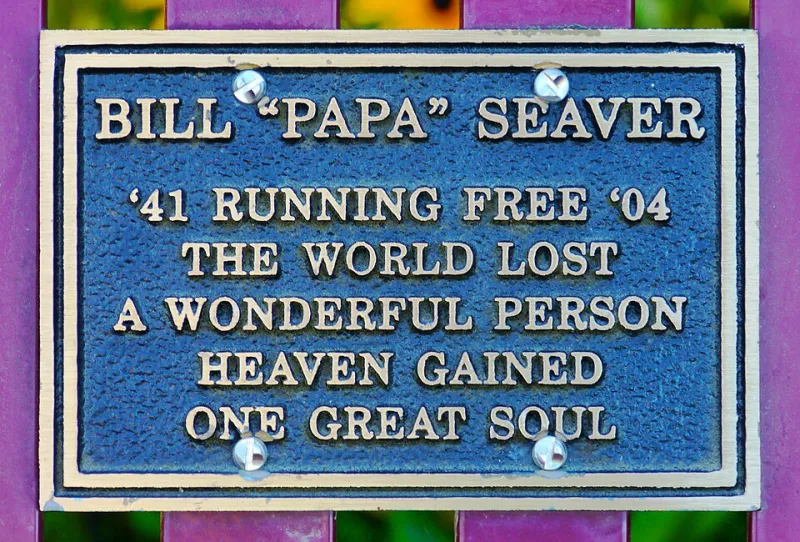
Photo: Rick Obst, CC BY 2.0, via Wikimedia Commons
There is a bench on the promenade at Llandudno, facing roughly north-west, that has been sat on by more people than most parish churches have seen through their doors. Its plaque commemorates a woman who died in 2009 and who, according to the brass, fed the gulls and fed everyone. The gulls have outlived her. The bench has not yet.
Walk any British seafront and you will find this: a run of seats, each with its small oblong of engraved metal, each a life compressed into two dates and a clause. Scarborough, Brighton, Bexhill, Portrush, the prom at Douglas, the green in a thousand villages, the up-platform at a station where the trains are now twice an hour. They are, taken together, the largest and least discussed body of public memorial in the country — and the most useful.
The Plaque Economy
A memorial bench is a transaction, and it is worth being clear about that before we get sentimental. A bereaved family approaches a council, chooses from an approved range, pays a sum — typically between three hundred and a thousand pounds, depending on the authority and the setting — and receives a tenancy, ten years being common. The bench remains council property. The council maintains it. The family, in most schemes, does not own the wood.
This is not a cynical arrangement. It is a rather remarkable one. Local authorities, at a time of acute financial strain, continue to operate programmes whose entire function is to allow strangers to sit down in memory of people they never met. A parks team will sand and re-stain a bench because someone’s mother liked that view. An officer will telephone a widow to explain that the plaque has been stolen for the second time and can be replaced at cost.
We do not usually call this service. We call it maintenance, or grounds, or the schedule of works. But it belongs to the same family of acts as the food bank and the church hall: the unglamorous provision of a place for someone else to be.
Who Gets a Seat
Here the story darkens slightly, as it should. A bench is not a right; it is an application, and applications favour the articulate, the persistent and the solvent. Waiting lists in popular spots run to years. Some authorities have closed their schemes altogether, citing maintenance liability and the difficulty of removing memorial furniture from coastal land that is eroding faster than the tenancy runs.
And a plaque is an odd kind of immortality, unevenly distributed. It rewards those with a family willing to fill in the form. The unclaimed, the estranged, the quietly unmemorialised — they get the bench as a piece of furniture, but not as a name.
There is also the awkwardness of the object itself. To sit on a bench is to occupy somebody’s grief for a few minutes with a sandwich. Most people do not read the plaque, and those who do often feel a small obligation they cannot quite discharge. What exactly is owed to a stranger’s mother on a Tuesday afternoon?
The Work of Keeping a Seat
In many towns the bench has acquired a second life as infrastructure for the lonely. The “happy to chat” bench — a movement usually traced to Cardiff, marked by a small sign inviting conversation from anyone who sits — is a clever retrofit of a form that already existed. Its insight is that a bench is not merely a place to rest; it is a licence to be present in public without purpose, which is one of the hardest things for a British person to do.
Councils, meanwhile, do the dull arithmetic. Bolts are checked. Rot is caught before it becomes a claim. Slats are replaced in kind, not in whatever timber is cheapest, because the family will notice. When a bench is beyond saving it is removed, and the plaque is carefully set aside — and here is a small, unpublicised grief: the depots and store cupboards where uncollected plaques accumulate, labels fading, waiting for a relative who has moved away or died or simply not thought to ask.
A Small Taxonomy of Inscriptions
The following are composites, written in the register of the form rather than quoted from any one seat. Anyone who has walked a promenade will recognise all of them.
- The plain and unbearable: “For Doreen, 1931–2009. She fed the gulls. She fed everyone.”
- The joke that isn’t quite one: “Bill: forty years, two wars, one wife, endless tea.”
- The instruction: “Sit. That’s what he’d have wanted.”
- The local claim: “Best view in town, and she knew it.”
- The abdication: “In memory of a man who always gave up his seat.”
- The sentence that does the most work with the least: “Here, for a while, everything was all right.”
Note the grammar of the form. Almost none of them mention achievement. The bench is not the medium of the career; it is the medium of the habit — the walk, the view, the dog, the flask, the daily circuit of the same three hundred yards. It is a memorial to repetition, which is to say a memorial to ordinary faithfulness.
Sitting With, Not On
There is an argument, made by sensible people, that memorial benches are a sentimental diversion from the serious business of public space: that a bench should exist because people need to sit, not because a family can pay for a plaque, and that commemoration quietly privatises what ought to be common.
It is a good argument. And yet the bench survives it, because the plaque does something the plain bench cannot. It tells the person sitting down that this place has already been loved by someone they will never meet — that the view has a history of being looked at. In a country that increasingly treats public space as a problem to be managed, that is a small and useful heresy.
The Empty Bench
Go out at this time of year, when the light goes at half past four and the promenade empties. The benches stay. Wind moves along them. Somewhere a parks officer is compiling a list of timber to order in the spring.
The quiet duty of making room is not much spoken of, because it produces nothing you can photograph well and no one to thank. But it is the whole of the thing, really: to keep a seat dry, facing the sea, with a stranger’s name on it, for whoever needs to sit down next. A society is legible in what it maintains for people it will never meet.